Studying the Josephson current phase relation in Bi2Se3 nanoribbons

Read our work on topological insulator Bi2Se3 nanobelt, done in collaboration with the group of Donats Erts at the University of Latvia. The paper has been recently published, fully open access, on Superconductor Science and Technology (link).

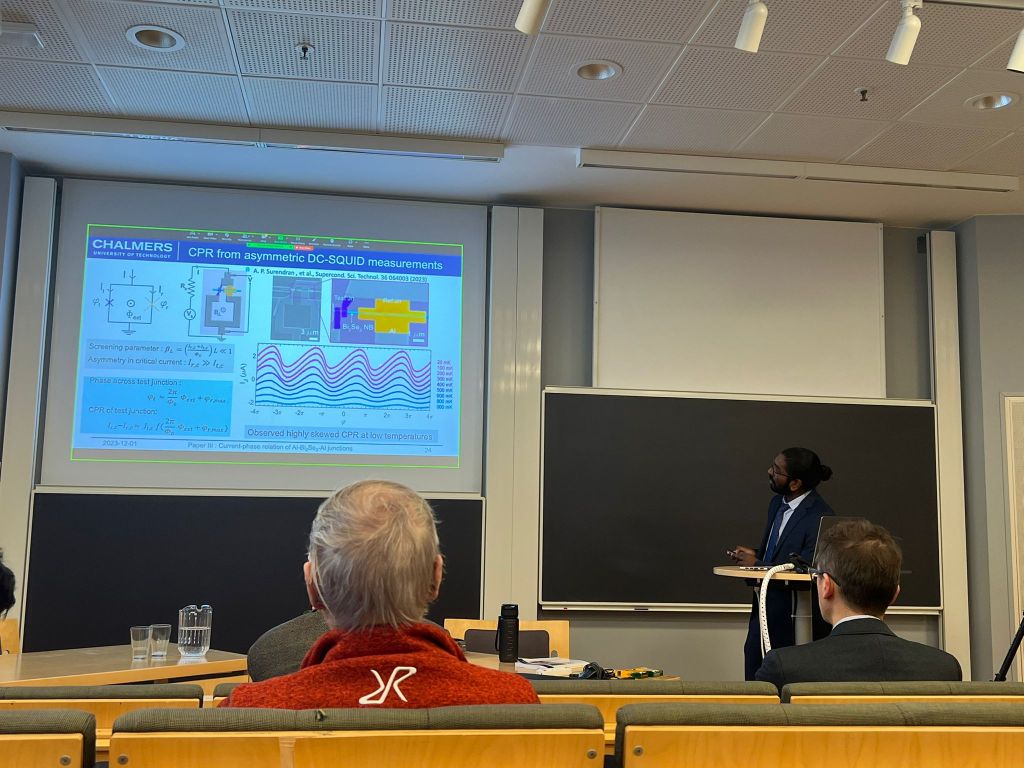
In this work, we have utilized the asymmetric superconducting quantum interference device (SQUID) technique to extract the current phase relation (CPR) of a Josephson junction with a 3D topological insulator (3D-TI) Bi2Se3 nanobelt as the barrier. The obtained CPR shows deviations from the standard sinusoidal CPR with a pronounced forward skewness. At temperatures below 200 mK, the junction skewness values are above the zero temperature limit for short diffusive junctions. Fitting of the extracted CPR shows that most of the supercurrent is carried by ballistic topological surface states (TSSs), with a small contribution of diffusive channels primarily due to the bulk. These findings are instrumental in engineering devices that can fully exploit the properties of the topologically protected surface states of 3D TIs.

Determining the upper magnetic critical field in YBCO films

In the quest to increase the critical temperature of superconductors, it is essential to identify the factors that limit the strength of superconductivity. The upper critical field Hc,2 is a fundamental measure of that strength. Only in recent years, its magnitude and doping dependence has been measured in cuprate superconductors, but only when they are in single crystal form. It is therefore very interesting to measure its behavior in thin films, where the ground state can be modified through strain and intertwining and competition between different orders can be enhanced.

For the abovementioned reasons, in the work, written by our postdoc Eric Wahlberg and published on Superconductor Science and Technology (link), we have reported on measurements of the doping dependence of the upper critical field Hc,2 in 50 nm thick YBa2Cu3O7−δ films. The films are untwinned and are characterized by a small in-plane compressive strain. We find that the Hc,2 shows a strong decrease in the underdoped region of the phase diagram, in agreement with what has been measured in relaxed single crystals. The origin of the decrease of Hc,2 in the underdoped regime is discussed within a scenario where charge density wave order competes with superconductivity.

This work demonstrates the potential of using thin films for studying the phase diagram of high-Tc materials under strain, and opens up the possibility to investigate the interplay between charge density wave order and superconductivity tuned by strain.

WISE PhD project accepted

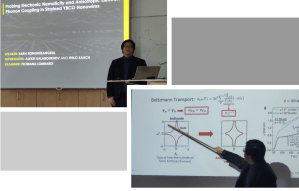
WISE, the Wallenberg Initiative Material Science for Sustainability, launched during summer the first call for Academic PhD-student and postdoctoral research projects. The call was intended to attract research projects addressing sustainability challenges for materials science.

After the evaluation, 90 projects have been granted, and among these the project “Strain engineering of High-Tc thin films for clean energy”, applied by Floriana Lombardi, got funding. To read more on the call and on the granted projects you can read here and here!

Nanometric Moiré Stripes on the Surface of Bi2Se3 TI

Read our work on topological insulator Bi2Se3 nanobelt, done in collaboration with Matteo Salvato from Università di Roma “Tor Vergata” and with the group of Donats Erts at University of Latvia. The paper has been recently published on ACS Nano (link).

Mismatch between adjacent atomic layers in low-dimensional materials, generating moiré patterns, has recently emerged as a suitable method to tune electronic properties by inducing strong electron correlations and generating novel phenomena. Beyond graphene, van der Waals structures such as three-dimensional (3D) topological insulators (TIs) appear as ideal candidates for the study of these phenomena due to the weak coupling between layers.

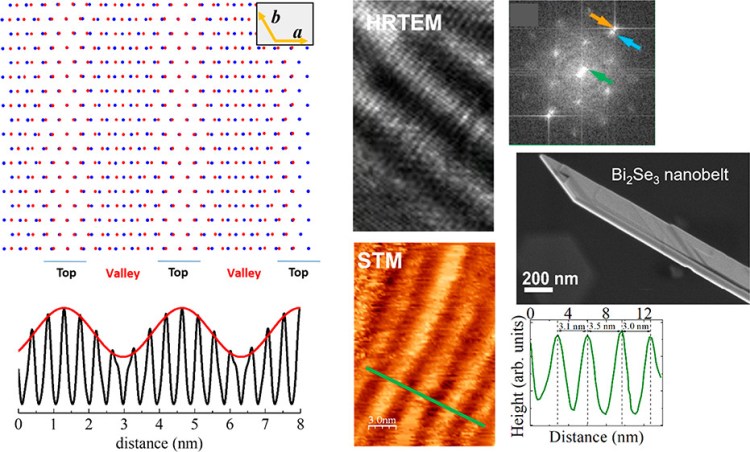
In this work we have discovered and investigated the origin of 1D moiré stripes on the surface of Bi2Se3 TI thin films and nanobelts, using scanning tunneling microscopy and high-resolution transmission electron microscopy. The 1D stripes are characterized by a spatial modulation of the local density of states, which is strongly enhanced compared to the bulk system. Density functional theory calculations confirm the experimental findings.

The strongly enhanced density of surface states in the TI 1D moiré superstructure can be instrumental in promoting strong correlations in the topological surface states, which can be responsible for surface magnetism and topological superconductivity.

QManD @ the Nordic Nanolab User Meeting 2022

After a forced pause of a couple of years, it is finally time to meet at conferences, taking part in lectures and tutorials and discussing research ideas and results with each other.

The first chance has arrived from the third Nordic Nanolab User Meeting (NNUM), which took place at Chalmers on May 5-6.

The Nordic Nanolab Network is a collaborative network formed by the national research infrastructures for micro- and nanofabrication in the Nordic countries.

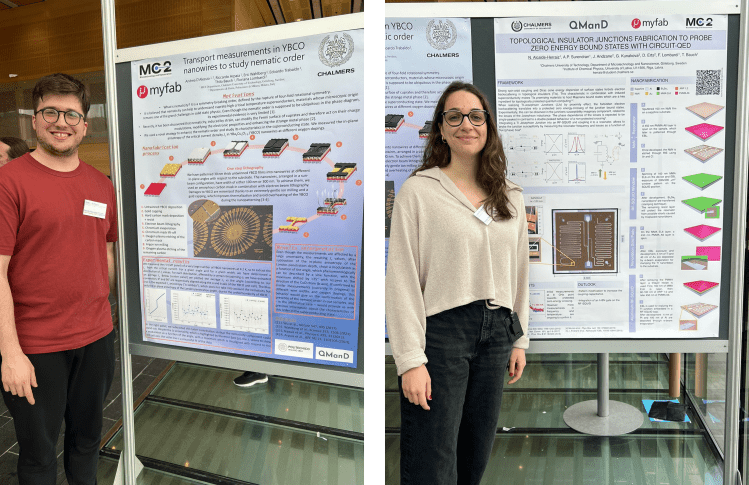
QManD took part to the meeting thanks to the posters presented by the master students Andrea D’Alessio and Núria Alcalde Herraiz, and respectively entitled “Transport measurements in YBCO nanowires to study nematic order” (left panel) and “Topological Insulator junctions fabrication to probe zero energy bound states with circuit-QED” (right panel).

To read more on the meeting you can read here!

A new way to control quantum materials

Illustration: Yen Strandqvist

Read our new article, ‘Restored strange metal phase through suppression of charge density waves in underdoped YBa2Cu3O7–δ’, now available in the leading scientific journal Science. The research has been led by our group, in collaboration with researchers from Politecnico di Milano, University La Sapienza, Brandenburg University of Technology and the European Synchrotron facility (ESRF).

The presented research focuses on understanding and controlling the enigmatic state called ‘strange metal’, appearing in high temperature superconductors at temperatures above the superconducting transition.

The main result of the paper is new evidence of an intimate connection between the strange metal state and a “directional” local charge modulation in the conducting electrons called charge density waves (CDW). More specifically, the strange metal state is suppressed by the appearance of these charge modulations, providing valuable insights into the possible mechanism behind this enigmatic state.

The experiment also shows that CDW can be controlled by applying strain to the material, leading to a novel technique of using strain to turn the strange metal state on or off. This is the first step towards a systematic study of ultra quantum matter in the lab, where strain control can be used to manipulate this new class of quantum materials.

Read more about our paper here!

Tuning the oxygen content of YBCO nanowire with electromigration

Precise control of the doping in cuprate high-Tc superconductors is fundamental for studying the phase diagram of these materials, and can have a crucial role for technological applications. We recently developed a novel procedure, in order to tune the doping of YBCO nanostructures by using an ex-situ electromigration (EM). On this topic, we have recently published two papers.

In the first work, published on Physical Review Applied and featured as editors’ suggestion (link), we have shown that an AC biasing scheme allows to fine tune the oxygen content in our nanowires. A phase diagram, in good agreement with that of bulk YBCO, can be built using a single nanowire and successive steps of EM. Kelvin Probe Atomic Force Microscopy, used to investigate homogeneity of the nanowires after EM, confirmed the uniform distribution of oxygen atoms within the nanowires.

In the second work, published on Superconductor Science and Technology (link), we have used EM to tune the superconducting properties of nanowires-based SQUIDs. Here, EM is instrumental to suppress the critical current of the SQUID, therefore enhancing the voltage modulation depth by factors as high as 8. This result shows that EM can be used to significantly improve the nanoSQUIDs performances. Moreover, this technique can be extended to a large range of devices: indeed, it is particularly well suited for constriction type weak links and grooved Dayem bridges, where EM is expected to occur locally.