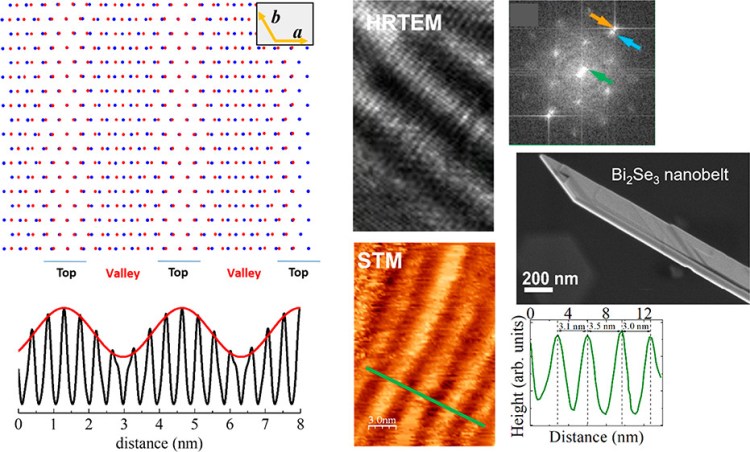
Read our work on topological insulator Bi2Se3 nanobelt, done in collaboration with Matteo Salvato from Università di Roma “Tor Vergata” and with the group of Donats Erts at University of Latvia. The paper has been recently published on ACS Nano (link).
Mismatch between adjacent atomic layers in low-dimensional materials, generating moiré patterns, has recently emerged as a suitable method to tune electronic properties by inducing strong electron correlations and generating novel phenomena. Beyond graphene, van der Waals structures such as three-dimensional (3D) topological insulators (TIs) appear as ideal candidates for the study of these phenomena due to the weak coupling between layers.
In this work we have discovered and investigated the origin of 1D moiré stripes on the surface of Bi2Se3 TI thin films and nanobelts, using scanning tunneling microscopy and high-resolution transmission electron microscopy. The 1D stripes are characterized by a spatial modulation of the local density of states, which is strongly enhanced compared to the bulk system. Density functional theory calculations confirm the experimental findings.
The strongly enhanced density of surface states in the TI 1D moiré superstructure can be instrumental in promoting strong correlations in the topological surface states, which can be responsible for surface magnetism and topological superconductivity.
 QManD
QManD 